What Is Melamine?
Melamine is a nitrogen-rich organic compound used mainly as an industrial intermediate. Its chemical name is 1,3,5-triazine-2,4,6-triamine, and it normally appears as a white crystalline powder.
Most melamine is not used directly in a finished article. It is reacted with formaldehyde or combined with other chemicals to produce thermosetting resins, adhesives, molding compounds, coatings and flame-retardant systems.
| Property | Information |
Chemical name | 1,3,5-Triazine-2,4,6-triamine |
Common name | Melamine |
CAS number | 108-78-1 |
Molecular formula | C3H6N6 |
Molecular weight | 126.12 g/mol |
Appearance | White crystalline powder |
Chemical family | Nitrogen-containing heterocyclic compound |
Primary industrial role | Intermediate for amino resins and other functional materials |
Melamine contains approximately 66% nitrogen by weight. Its three amino groups also allow it to react readily with formaldehyde and form a dense, crosslinked thermosetting structure.
Why Is Melamine Useful in Industrial Materials?
Melamine is valuable because it can provide a combination of:
Surface hardness
Scratch and abrasion resistance
Heat resistance
Chemical and stain resistance
Moisture resistance
Dimensional stability
Electrical insulation
Nitrogen-based flame-retardant performance
Compatibility with decorative surfaces
These properties usually come from a melamine-derived resin or compound rather than from free melamine powder alone.
Industry data indicate that laminates and wood adhesives account for more than 70% of global melamine consumption. Construction, furniture, automotive products and other manufactured materials are therefore major demand drivers.
What Are the Main Uses of Melamine?
1. Decorative Laminates and Furniture Surfaces
One of the largest uses of melamine is the production of decorative laminates.
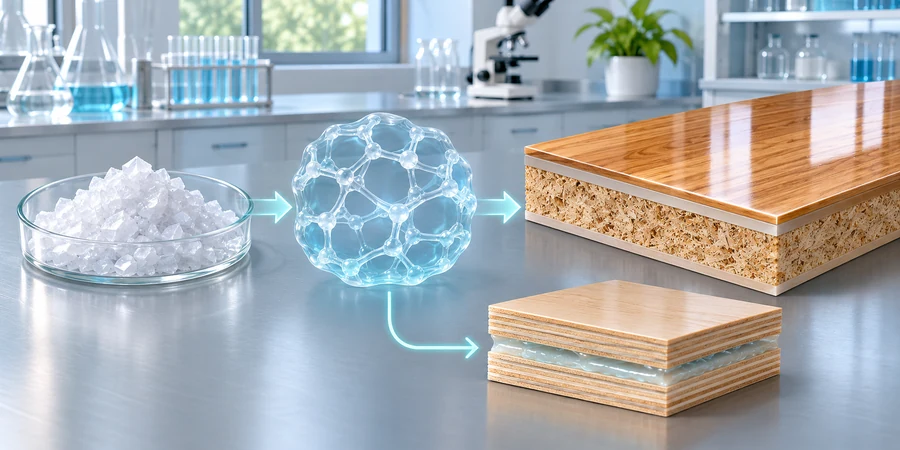
Printed or colored paper is impregnated with melamine-formaldehyde resin and bonded to a wood-based substrate under heat and pressure. During curing, the resin forms a hard thermoset surface.
Melamine laminates are commonly used for:
Kitchen cabinets
Countertops
Furniture panels
Shelving
Office desks
Interior wall panels
Laminate flooring
Retail display systems
The resin helps the decorative surface resist scratches, stains, household chemicals and moderate heat.
“Melamine furniture” normally refers to wood-based panels covered with melamine-impregnated decorative paper. It does not mean that the entire panel consists of pure melamine.
2. Wood Adhesives and Engineered Wood Products
Melamine is also used to modify formaldehyde-based wood adhesives.
Melamine-urea-formaldehyde, commonly abbreviated as MUF, combines the lower cost of urea-formaldehyde chemistry with improved moisture and heat resistance from melamine.
Melamine-containing adhesives can be used in:
The appropriate melamine content depends on the required bond durability, moisture exposure, press cycle, emissions target and manufacturing cost.
3. Molding Compounds and Durable Household Articles
Melamine-formaldehyde molding compounds can be formed under heat and pressure into hard, dimensionally stable articles.
Applications include:
Plates, bowls and serving utensils
Electrical switches and sockets
Appliance components
Handles and knobs
Decorative buttons
Industrial housings
Sanitary and institutional products
Molding compounds may also contain cellulose, pigments and other additives. The finished material is a cured thermoset and cannot simply be melted and reshaped like a conventional thermoplastic.
4. Industrial and Automotive Coatings
Melamine-derived resins are widely used as crosslinkers in baked coating systems. They react with suitable hydroxyl-, carboxyl- or amide-functional polymers during curing.
Potential coating applications include:
Melamine crosslinkers can improve hardness, gloss, chemical resistance and durability. Their performance depends on resin type, catalyst, curing temperature and the functional polymer used with them.
Not all coatings use the same melamine resin. Fully alkylated, partially alkylated and high-imino grades can produce different cure responses and film properties.
5. Paper and Textile Treatment
Melamine resins may be used to improve the wet strength, dimensional stability and surface durability of paper.
Applications can include:
In textiles, melamine-derived finishing resins have historically been used to improve wrinkle resistance, dimensional stability and flame resistance.
The formulation must balance performance against stiffness, yellowing, residual formaldehyde and fabric-handling requirements.
6. Flame-Retardant Systems
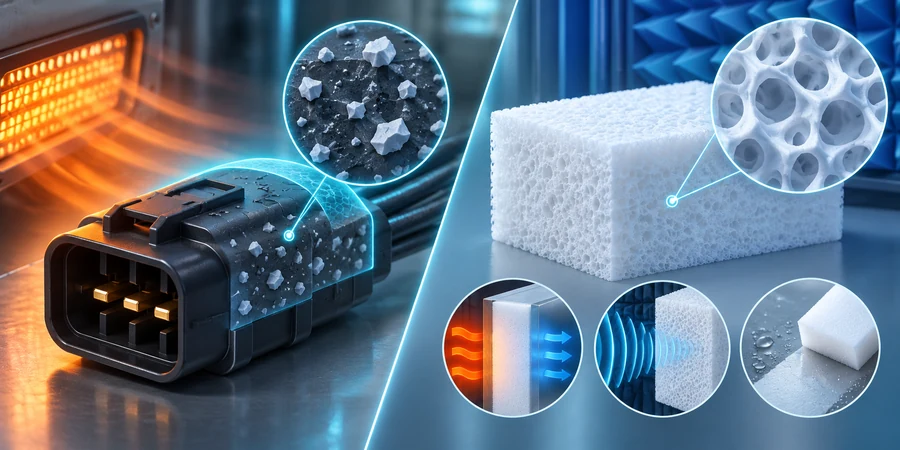
Melamine’s high nitrogen content makes it useful in several halogen-free flame-retardant systems. However, the active material is often a melamine salt rather than ordinary melamine.
Important examples include:
Melamine cyanurate is particularly associated with flame-retardant polyamide materials such as nylon 6 and nylon 66.
Depending on the formulation, melamine-based flame retardants can release non-combustible gases, absorb heat, encourage protective char formation or modify polymer decomposition. The exact mechanism varies with the polymer and flame-retardant chemistry.
A flame-retardant grade should be evaluated for particle size, dispersion, thermal stability, electrical properties, mechanical-property retention and the required fire-test standard.
7. Melamine Foam
Melamine foam is a lightweight, open-cell material produced from melamine-formaldehyde resin.
Its three-dimensional cellular structure can provide:
Melamine foam is used in acoustic panels, building insulation, transportation interiors, industrial equipment and household cleaning products.
A melamine cleaning sponge works through its fine, hard, open-cell structure. Its cleaning performance is primarily physical rather than dependent on releasing a detergent.
8. Concrete and Mortar Admixtures
Sulfonated melamine-formaldehyde condensates have been used as high-range water reducers or superplasticizers in concrete and mortar.
These dispersants can improve cement-particle dispersion, allowing a workable mixture to be produced with less water. Potential benefits include:
Higher early strength
Improved flow
Reduced water-to-cement ratio
Dense finished concrete
Better performance in precast products
Improved placement of specialized cement systems
Sulfonated melamine-formaldehyde is a downstream polymeric admixture. Adding ordinary melamine powder directly to concrete is not equivalent.
Modern polycarboxylate ether superplasticizers have replaced melamine-based products in many applications, but melamine condensates remain relevant where their specific setting and early-strength characteristics are useful.
Is Melamine the Same as Melamine Resin?
No. These terms describe different materials.
Term | Meaning | Typical role |
Melamine | Individual chemical, CAS 108-78-1 | Industrial raw material |
Melamine-formaldehyde resin | Crosslinked thermosetting resin made from melamine and formaldehyde | Laminates, molding compounds, coatings and foam |
Melamine-urea-formaldehyde resin | Resin containing both melamine and urea components | Moisture-resistant wood adhesives |
Melamine cyanurate | Hydrogen-bonded melamine and cyanuric acid complex | Flame retardant for selected engineering plastics |
Melamine polyphosphate | Phosphorus- and nitrogen-containing salt | Intumescent flame-retardant systems |
Sulfonated melamine-formaldehyde | Water-soluble condensation polymer | Concrete and mortar dispersant |
The distinction matters for specifications, safety data, processing conditions and regulatory compliance.
What Properties Does Melamine Add to Finished Products?
The final properties depend on the downstream chemistry, but melamine-derived materials are generally selected for one or more of the following reasons.
Hard and Durable Surfaces
Crosslinked MF resin provides hardness, scratch resistance and stain resistance in laminates and molded products.
Moisture-Resistant Bonding
Melamine modification can improve the water resistance of wood adhesives compared with standard urea-formaldehyde systems.
Thermal and Chemical Resistance
Melamine resins can withstand heat and many common chemicals better than several lower-cost resin systems.
Flame-Retardant Performance
Melamine salts provide nitrogen-rich alternatives for selected halogen-free flame-retardant formulations.
Electrical Insulation
Melamine molding compounds can offer dimensional stability and insulating properties for electrical components.
What Are the Limitations of Melamine-Based Materials?
Melamine chemistry also involves trade-offs.
Brittleness
Fully cured MF resin can be hard but brittle. Toughening agents, fillers or blended resin systems may be needed.
Formaldehyde Management
MF and MUF resin production must control free formaldehyde, curing emissions and finished-product emissions. Performance claims should be supported by the applicable test method.
Limited Recyclability
Cured thermoset resins cannot be remelted like thermoplastics. Mechanical recycling, chemical recovery and alternative end-of-life technologies are still developing.
Processing Sensitivity
Resin ratio, pH, catalyst, temperature and curing time influence final properties. Improper processing can cause incomplete cure, cracking, poor bonding or excessive emissions.
Regulatory Requirements
Melamine and its downstream products may be subject to different chemical, workplace, environmental and food-contact regulations.
Is Melamine Safe for Food-Contact Products?
Melamine itself is not approved for direct addition to food or animal feed in the United States. It has been associated with serious kidney damage when deliberately or accidentally present in food at high levels, particularly when combined with related compounds such as cyanuric acid.
Melamine-formaldehyde resin may be used to manufacture compliant food-contact articles, including certain plates and utensils. This is different from adding melamine to food.
According to the FDA, migration from properly manufactured tableware is generally low under normal serving conditions. However, migration can increase when highly acidic food is exposed to high temperatures.
Practical precautions include:
Follow the tableware manufacturer’s instructions.
Do not microwave melamine tableware unless it is specifically approved for that use.
Do not use damaged or heavily scratched articles for high-temperature service.
Select products that comply with the regulations of the target market.
Test migration using the required food simulants, time and temperature.
Compliance cannot be determined from appearance alone.
What Should Buyers Compare When Purchasing Melamine?
Common purchasing parameters include:
The most important specification depends on the application.
Application | Particularly important factors |
Decorative laminates | Color, clarity, purity and resin reactivity |
Wood adhesives | Reactivity, moisture and consistent impurity profile |
Coatings | Color, resin compatibility and cure response |
Molding compounds | Purity, color and batch consistency |
Flame retardants | Identity of downstream salt, particle size and thermal behavior |
Foam production | Resin reactivity and foam-processing consistency |
Concrete admixtures | Downstream polymer properties rather than raw melamine alone |
When requesting a quotation from AOZUN or another supplier, provide the intended application and target specification rather than asking only for “industrial-grade melamine.”
What Documentation Should a Supplier Provide?
A qualified supplier should provide, as applicable:
Certificate of analysis
Safety data sheet
Technical data sheet
Batch and manufacturing traceability
Packaging information
Storage and shelf-life guidance
Regulatory statements requested for the destination market
Information about changes to specifications or manufacturing source
Food-contact, low-emission or flame-retardant claims require application-specific documentation. A raw-material COA alone does not certify the final product.
What Are the Future Trends in Melamine Applications?
Lower-Emission Resins
Research continues into lower-formaldehyde MF and MUF resins, alternative crosslinkers and improved curing efficiency.
Toughened Melamine Thermosets
Chemical modification, flexible segments, nanoparticles and polymer blending are being investigated to reduce brittleness.
Advanced Melamine Foam
Emerging foam research includes oil–water separation, filtration, energy absorption, acoustic control and functional surface modification.
More Efficient Flame Retardants
Surface-modified and nanoscale melamine cyanurate systems may improve dispersion and reduce the trade-off between flame resistance and mechanical properties.
Thermoset Recycling
Chemical recycling, controlled depolymerization and reuse of ground thermoset material remain important development areas.
Frequently Asked Questions About Melamine
What is the largest use of melamine?
The largest uses are decorative laminates and wood adhesives. Together, these applications account for the majority of global melamine consumption.
Is melamine a type of plastic?
Melamine is a chemical raw material, not a finished plastic. Melamine-formaldehyde resin is the thermosetting plastic commonly called “melamine.”
Is melamine used in furniture?
Yes. It is used in decorative surface papers and in some adhesives that bond wood fibers, chips or veneer.
Why is melamine used in kitchen cabinets and countertops?
Cured melamine resin provides a hard surface with good scratch, stain, moisture and chemical resistance.
Is melamine used as a flame retardant?
Yes, but the materials are often melamine salts such as melamine cyanurate or melamine polyphosphate rather than ordinary melamine.
Is a melamine sponge made from pure melamine?
No. It is an open-cell foam produced from melamine-formaldehyde resin.
Can melamine tableware go in a microwave?
It should not be microwaved unless the manufacturer specifically states that it is suitable. FDA guidance recommends using microwave-safe cookware for heating food.
Is melamine added to food?
No. Melamine is not an approved direct food additive in the United States. Its legitimate food-related use is in certain regulated food-contact materials.
Conclusion
Melamine is mainly an industrial building block rather than a material used alone. Its most important role is the production of melamine-formaldehyde and melamine-modified resins.
These materials support decorative laminates, engineered wood, molding compounds, industrial coatings, treated paper, textiles and melamine foam. Melamine salts and condensation polymers also extend its use into flame-retardant plastics and concrete admixtures.
Selecting the right product requires identifying the actual downstream chemistry, required performance, impurity limits and applicable regulatory obligations—not simply purchasing a generic melamine grade.

 English
 العربية
 Français
 Русский
 Español
 Português
 Deutsch
 italiano
 日本語
 한국어
 Nederlands
 Tiếng Việt
 ไทย
 Polski
 Türkçe
 አማርኛ
 ភាសាខ្មែរ
 Bahasa Melayu
 ဗမာစာ
 Filipino
 Bahasa Indonesia
 magyar
 Română
 Čeština
 қазақ
 हिन्दी
 فارسی
 Kiswahili
 Slovenčina
 Slovenščina
 Norsk
 Svenska
 українська
 Ελληνικά
 Suomi
 עברית
 Latine
 Dansk
 اردو
 বাংলা
 Hrvatski
 Afrikaans
 Eesti keel
 සිංහල
 latviešu
 Български
 Hausa
 íslenska
 Kurdî
 Lietuvių
 isiZulu