What Is Hexamethylenediamine Tetramethylene Phosphonic Acid?
Hexamethylenediamine tetramethylene phosphonic acid is a multifunctional aminophosphonic acid commonly abbreviated as HDTMPA, HDTMP or HMDTMPA. Its established industrial role is the control of mineral scale and metal-ion behavior in demanding aqueous systems. More recent research is extending the molecule into coordination materials, functional coatings and proton-conducting networks.
The term “hexanediaminetetramethylphosphonic acid” sometimes appears in searches, but hexamethylenediamine tetramethylene phosphonic acid is the more precise standardized name.
| Property | Information |
Standard chemical name | Hexamethylenediamine tetramethylene phosphonic acid |
Common abbreviations | HDTMPA, HDTMP, HMDTMPA |
CAS number | 23605-74-5 |
Molecular formula | C10H28N2O12P4 |
Relative molecular mass | 492.23 |
Chemical family | Aminophosphonic acid / organophosphorus compound |
Established function | Scale inhibition and metal-ion complexation |
Emerging research areas | Coordination materials, functional coatings and proton-conducting catalyst layers |
HDTMPA should not be confused with ethylenediamine tetramethylene phosphonic acid, or EDTMPA. The two compounds have different molecular backbones and CAS numbers.
Acid, sodium, potassium and other neutralized forms may also differ in active content, solubility, pH and handling properties. Product form must therefore be confirmed before laboratory evaluation or formulation.
Why Can HDTMPA Be Described as a “Network” Molecule?
HDTMPA contains two nitrogen centers and four phosphonic acid groups connected by a flexible six-carbon chain. This structure provides multiple sites for metal coordination, hydrogen bonding and surface attachment.
Instead of performing only one isolated function, HDTMPA can participate in several interacting networks:
Network level | Primary interaction | Potential result |
Molecular network | Coordination with dissolved metal ions | Modified ion availability and precipitation behavior |
Interfacial network | Adsorption at mineral or metal surfaces | Delayed nucleation and altered crystal growth |
Materials network | Metal–phosphonate and hydrogen-bond interactions | Functional coatings or hybrid structures |
Process network | Connection with sensors, dosing equipment and control models | More responsive chemical treatment |
Environmental network | Separation, oxidation and phosphorus management | Better end-of-life control |
These behaviors are not constant under every condition. They depend on pH, neutralization state, metal identity, ionic strength, temperature and competing ligands.
How Does HDTMPA Build a Scale-Control Network at the Mineral–Water Interface?
In scale control, HDTMPA does more than bind a fixed quantity of calcium. At appropriately selected concentrations, phosphonate groups can interact with ions, crystal nuclei and growing mineral surfaces.
A 2021 study of a forward-osmosis–membrane-distillation process found that HDTMPA complexed with calcium, interfered with gypsum nucleation and growth, and produced a looser, more deformed deposit. The reported water-flux recovery exceeded 90% after three scaling and cleaning cycles under the tested conditions.
That distinction is essential: HDTMPA is primarily a preventive control tool, not a substitute for mechanical or chemical descaling.
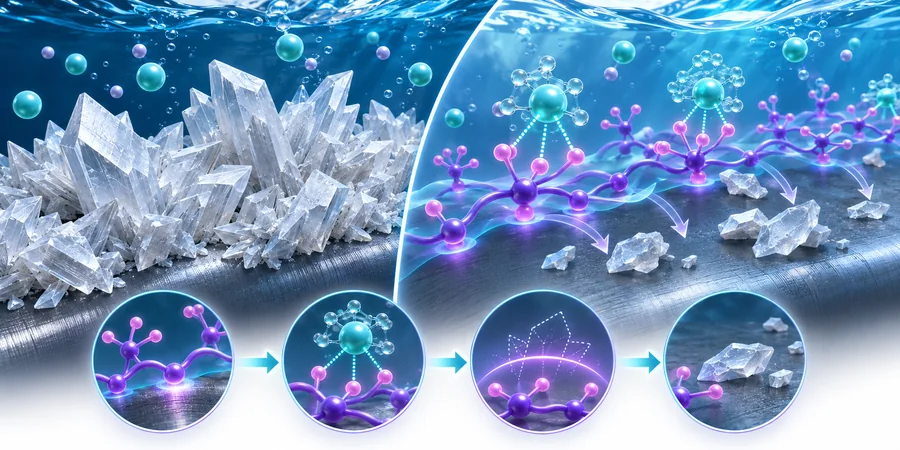
Four Interacting Scale-Control Mechanisms
Metal-ion coordination: Phosphonate groups interact with calcium and other multivalent ions, changing their effective availability.
Nucleation delay: HDTMPA can increase the time required for stable crystal nuclei to form.
Crystal-growth modification: Adsorption at active growth sites can alter crystal shape and create less compact deposits.
Surface interaction: Adsorption on mineral or equipment surfaces may reduce the probability of strongly attached scale formation.
The relative contribution of each mechanism depends on the water chemistry. A dosage that works in one cooling-water or membrane system should not automatically be transferred to another.
Which Operating Variables Matter Most?
An HDTMPA evaluation should include:
Calcium, magnesium, barium and iron concentrations
Carbonate alkalinity and sulfate concentration
pH and ionic strength
Temperature and residence time
Cycles of concentration
Membrane or equipment surface material
Oxidants and biocides
Dispersant polymers and other formulation components
Target mineral saturation index
Published evidence is especially relevant to calcium sulfate control, while supplier literature also positions HDTMPA for other carbonate, sulfate and iron-containing deposits. Each target scale should be verified with representative water.
How Do HDTMPA Coordination Networks Extend Beyond Conventional Water Treatment?
The same multi-point coordination responsible for scale control makes HDTMPA interesting as a building block for inorganic–organic materials.
Researchers have reported polymeric zinc and calcium HDTMP coordination structures in which metal centers connect through phosphonate oxygen atoms. The zinc-containing material was also investigated for anticorrosion effects on carbon steel.
This work suggests three wider innovation paths:
Functional Metal–Phosphonate Coatings
HDTMPA may help create strongly attached interfacial layers on suitable metal or oxide surfaces. Possible research objectives include corrosion control, surface passivation and controlled interfacial mineralization.
Hybrid Coordination Materials
Because one HDTMPA molecule offers multiple coordination sites, it can connect more than one metal center. This supports the development of extended metal–organophosphonate structures rather than simple one-to-one complexes.
Controlled Biomineralization
A published magnesium-implant study used an HDTMPA-based coating to influence corrosion and bone-like apatite formation. These findings are application-specific laboratory research and should not be interpreted as authorization for medical use. They nevertheless demonstrate how a phosphonate coordination layer can influence both surface stability and mineral growth.
Can HDTMPA Create a Proton-Conduction Network in Fuel Cells?
A 2026 study introduced HDTMPA into the cathode catalyst layer of a high-temperature proton-exchange membrane fuel cell. The researchers proposed that HDTMPA helped anchor phosphoric acid through hydrogen bonding while supporting a three-dimensional proton-conduction network.
At the reported optimum, the modified membrane electrode assembly achieved a peak power density of 715 mW cm⁻² at 150°C, compared with 503 mW cm⁻² for the control. The study also reported 5.0% performance decay after 10,000 accelerated cycles, versus 17.5% for the unmodified control.
These figures are important research results, but they come from a defined laboratory formulation and test protocol. They should be treated as emerging, application-specific evidence rather than proof of universal commercial performance.
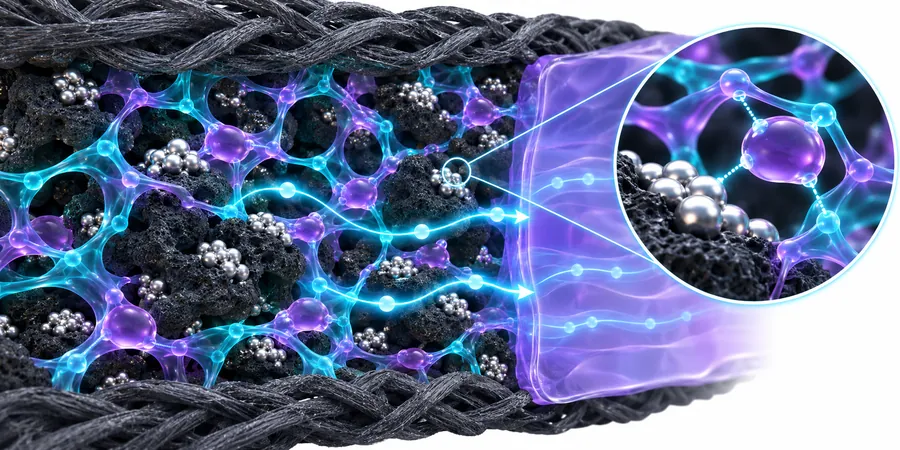
Why Does This Result Matter?
Phosphoric acid is required for proton conduction in this type of fuel cell, but uncontrolled acid migration can obstruct platinum catalyst sites and increase transport resistance.
The proposed HDTMPA network performs two complementary functions:
This represents a significant change in perspective. HDTMPA is no longer being considered only as a scale inhibitor; it is being investigated as a molecular organizer inside an electrochemical interface.
What Must Be Proven Next?
Before this approach can move toward wider industrial adoption, future work should address:
Independent reproduction of the reported performance
Longer operating tests under realistic fuel-cell conditions
Sensitivity to HDTMPA purity and catalyst-layer composition
Acid loss, impurity tolerance and thermal cycling
Manufacturing consistency at larger electrode areas
Cost and lifecycle comparison with alternative additives
How Can HDTMPA Be Connected to a Digital Process-Control Network?
In industrial water treatment, the molecule itself does not need to be digitally active. Innovation occurs when HDTMPA dosing is connected to reliable process data.
A modern control system may combine:
Flow and makeup-water measurements
Conductivity and cycles of concentration
pH, temperature and oxidation-reduction potential
Online or laboratory hardness data
Membrane pressure, heat-transfer or differential-pressure trends
Deposit analysis and corrosion monitoring
Dosing-pump status and chemical consumption
These variables can support feed-forward, feedback or model-predictive dosing. However, common online sensors do not directly prove that HDTMPA is preventing scale. Performance must still be confirmed through deposit analysis, mass balance, equipment inspection and suitable analytical methods.
Machine learning may improve forecasting when sufficient high-quality operating data exist, but it cannot compensate for incorrect product identity, poor water analysis or an unvalidated treatment model.
What Does Responsible Environmental Design Require?
A technology should be evaluated across its complete lifecycle. Strong complexation and chemical stability are useful during treatment, but they can complicate downstream removal.
Research has described aminophosphonates such as HDTMP as persistent substances under conventional treatment conditions. Photochemical and advanced oxidation pathways are therefore receiving increasing attention.
A 2020 study found that adding hydrogen peroxide accelerated HDTMP photodegradation under the investigated UV conditions. A separate industrial-wastewater study reported that a combination of flocculation and subsequent oxidation removed up to 98% of the tested potassium HDTMPA salt under optimized experimental conditions.
These results should not be converted into a universal treatment recipe. Wastewater composition, product concentration, metal content and oxidant demand can change the outcome substantially.
A responsible HDTMPA program should consider:
The minimum effective dose rather than maximum routine dosing
Total phosphorus entering the discharge stream
Interference with metal or phosphate precipitation
Transformation products formed during oxidation
Sludge partitioning and disposal
Local discharge requirements
Opportunities for phosphorus recovery
The future of phosphonate chemistry will depend not only on performance during use, but also on how effectively the molecule and its phosphorus content are managed afterward.
What Are the Most Promising HDTMPA Technology Frontiers?
Innovation frontier | Current evidence | Development status |
Calcium sulfate scale control | Membrane and industrial water research | Established application with system-specific validation |
Metal–phosphonate hybrid structures | Crystallographic and corrosion studies | Research and specialized materials development |
Functional magnesium coatings | Laboratory materials and biological studies | Application-specific research |
HT-PEM fuel-cell catalyst layers | 2026 electrochemical study | Emerging frontier |
Sensor-linked chemical dosing | Established process-control tools applied to phosphonate programs | Deployment depends on data quality |
HDTMPA wastewater degradation | UV, oxidation and flocculation studies | Active environmental research |
Phosphorus recovery | Broader organophosphonate treatment research | Developing circular-economy opportunity |
The strongest future projects will connect at least two levels—for example, molecular-scale surface control with digital dosing, or high-performance use with a validated end-of-life treatment route.
How Should HDTMPA Be Evaluated for Research or Industrial Use?
1. Confirm the Chemical Identity
Check the exact acid or salt form, CAS number, active content and molecular identity. Do not assume that HDTMPA, its sodium salt and its potassium salt are interchangeable.
2. Request Traceable Documentation
The supplier should provide an appropriate certificate of analysis, safety data sheet, technical data sheet, batch number and storage information.
When discussing HDTMPA with AOZUN or another supplier, specify whether the project requires water-treatment grade, high-purity research material or a neutralized salt.
3. Test Representative Conditions
Use actual or accurately simulated process water. Include realistic temperature, pH, residence time, concentration cycles and competing chemicals.
4. Measure More Than One Outcome
Depending on the application, useful measurements may include induction time, residual dissolved ions, deposit mass, crystal morphology, membrane flux, corrosion rate or electrochemical impedance.
5. Examine Chemical Compatibility
Evaluate HDTMPA with polymers, biocides, oxidants, metal salts and other phosphonates used in the formulation. Inspect for precipitation, activity loss and storage instability.
6. Design the Exit Route
Determine how residual HDTMPA, coordinated metals and phosphorus will be measured and treated before scaling up the application.
Frequently Asked Questions About HDTMPA
Is HDTMPA the same as EDTMPA?
No. HDTMPA contains a six-carbon hexamethylene bridge, while EDTMPA has a shorter ethylene bridge. They have different CAS numbers, physicochemical behavior and application profiles.
Is HDTMPA only a water-treatment chemical?
Water treatment is its established commercial field, but published research has also investigated metal–phosphonate materials, functional coatings and high-temperature fuel-cell catalyst layers.
Does HDTMPA remove existing mineral scale?
Its primary function is to prevent or reduce scale formation. Established deposits may require a separate cleaning program based on deposit composition and equipment compatibility.
Is the acid form identical to an HDTMPA salt?
No. Neutralization changes formula weight, pH, solubility and active-equivalent calculations. Procurement and dosing decisions should identify the precise form.
Is HDTMPA readily biodegradable?
It should not be described broadly as readily biodegradable. Published research identifies persistence concerns and investigates photolysis, advanced oxidation and microbial transformation. Environmental conclusions must be based on the relevant product form and local test method.
Is HDTMPA already a commercial fuel-cell additive?
The 2026 catalyst-layer study presents promising laboratory evidence. Broader validation, scale-up and commercial qualification are still required.
Conclusion
HDTMPA is best understood as more than a conventional chelant or scale inhibitor. Its four phosphonic acid groups and two nitrogen centers allow it to participate in ion-coordination, surface-adsorption and hydrogen-bonding networks.
These interactions support established scale-control applications while opening new research directions in coordination materials, functional coatings, digital process control and high-temperature fuel cells.
The most credible innovation strategy is not to claim that one molecule solves every problem. It is to identify the relevant network, validate it under realistic conditions and design the environmental exit route at the same time.

 English
 العربية
 Français
 Русский
 Español
 Português
 Deutsch
 italiano
 日本語
 한국어
 Nederlands
 Tiếng Việt
 ไทย
 Polski
 Türkçe
 አማርኛ
 ភាសាខ្មែរ
 Bahasa Melayu
 ဗမာစာ
 Filipino
 Bahasa Indonesia
 magyar
 Română
 Čeština
 қазақ
 हिन्दी
 فارسی
 Kiswahili
 Slovenčina
 Slovenščina
 Norsk
 Svenska
 українська
 Ελληνικά
 Suomi
 עברית
 Latine
 Dansk
 اردو
 বাংলা
 Hrvatski
 Afrikaans
 Eesti keel
 සිංහල
 latviešu
 Български
 Hausa
 íslenska
 Kurdî
 Lietuvių
 isiZulu