What Is Thiourea?
Thiourea is an organosulfur compound with the formula CH4N2S. It is the sulfur analogue of urea: the oxygen atom in urea is replaced by sulfur. Commercial thiourea normally appears as white or off-white crystals or crystalline powder.
Its combination of sulfur, nitrogen and hydrogen-bonding sites makes it useful in chemical synthesis, metal processing, polymer technology and pharmaceutical research.
| Property | Information |
Chemical name | Thiourea |
Alternative name | Thiocarbamide |
CAS number | 62-56-6 |
Molecular formula | CH4N2S |
Molecular weight | 76.12 g/mol |
Chemical class | Organosulfur compound |
Physical form | White or off-white crystalline material |
Relevant industries | Chemical synthesis, rubber, pharmaceuticals, mining, metal treatment and textiles |
Thiourea is not automatically interchangeable with its substituted derivatives. This distinction is especially important when discussing rubber accelerators and pharmaceutical applications.
What Is the Difference Between Thiourea and Thiourea Derivatives?
“Thiourea” can refer either to the individual substance with CAS 62-56-6 or, less precisely, to a family of compounds containing a thiourea functional group.
Material | Identity | Typical relevance |
Thiourea | CAS 62-56-6 | Chemical intermediate and raw material for downstream derivatives |
Ethylene thiourea | ETU, CAS 96-45-7 | Accelerator used especially in polychloroprene and some polyacrylate rubber systems |
Diethylthiourea | DETU, CAS 105-55-5 | Accelerator for selected chloroprene and other elastomer formulations |
Diphenylthiourea | DPTU or thiocarbanilide | Specialty rubber accelerator and organic intermediate |
Dibutylthiourea | DBTU | Rubber-processing and specialized industrial applications |
Substituted thioureas | Different alkyl, aryl or heterocyclic groups | Medicinal chemistry, catalysis and functional-material research |
A technically accurate article, specification or purchase order should identify the exact compound rather than describing every member of this family simply as “thiourea.”
How Is Thiourea Used in the Rubber Industry?
Thiourea has been documented as a rubber-processing accelerator and as an intermediate for producing substituted thiourea accelerators. In modern industrial formulations, however, ETU, DETU, DPTU and related derivatives are often more directly relevant than unsubstituted thiourea.
Accelerators help rubber compounds reach the required state of cure in less time or at a lower temperature. They affect crosslink formation and can influence scorch safety, cure rate, modulus, tensile performance, compression set and ageing behavior.
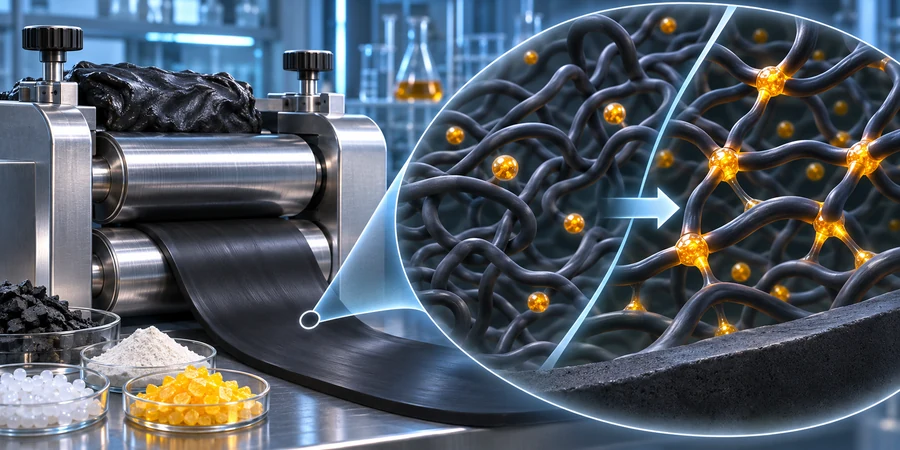
How Do Thiourea Accelerators Support Vulcanization?
Vulcanization transforms relatively mobile polymer chains into an elastic three-dimensional network. The accelerator participates in the curing system and promotes the formation of effective crosslinks.
The complete system may contain:
A base elastomer
Sulfur or another curing agent
A thiourea or alternative accelerator
Metal-oxide activators
Fatty-acid co-activators
Fillers and processing aids
Antioxidants and antiozonants
Retarders for scorch control
The accelerator should therefore be evaluated as part of the complete formulation. Its behavior cannot be predicted reliably from purity or dosage alone.
Which Rubber Types Use Thiourea-Based Accelerators?
Ethylene thiourea is particularly associated with the curing of polychloroprene, commonly known as chloroprene rubber or neoprene. It has also been used with polyacrylate elastomers.
Diethylthiourea has been described as an accelerator for chloroprene rubber and as a secondary accelerator in selected natural rubber, EPDM and styrene-butadiene rubber systems.
Potential end products include:
Industrial hoses
Seals and gaskets
Automotive rubber components
Wire and cable coverings
Adhesives
Belts and molded technical products
Oil- and heat-resistant elastomer components
The exact accelerator must be chosen according to the elastomer, cure system, processing temperature and regulatory requirements.
Which Formulation Variables Should Be Tested?
Rubber formulators should compare:
Mooney scorch time
Optimum cure time
Minimum and maximum torque
Crosslink density
Tensile strength and elongation
Tear resistance
Compression set
Heat and ageing resistance
Blooming or surface migration
Accelerator residue
Workplace exposure during mixing
Replacing one thiourea derivative with another may change both processing safety and final mechanical properties. Substitution should be supported by a complete cure study.
What Are the New Technology Frontiers for Thiourea in Rubber?
The traditional function of thiourea chemistry is cure acceleration, but newer research is exploring more advanced polymer networks.
Polymer-Bound and Low-Dust Accelerators
Polymer-bound or granulated accelerator forms can reduce airborne dust during weighing and mixing. This approach may improve material handling, dosing consistency and occupational exposure control.
Self-Healing Rubber Networks
A 2024 study investigated a thiourea-based polymer in a natural rubber and epoxidized natural rubber network. The researchers used a combination of covalent interactions and reversible hydrogen bonding to promote crack repair.
This represents an emerging research direction rather than a standard commercial use of ordinary thiourea. It shows how thiourea groups may contribute to dynamic polymer networks instead of acting only as conventional accelerators.
Data-Guided Cure Optimization
Modern rheometers, automated dosing equipment and statistical formulation tools allow rubber manufacturers to connect accelerator selection with real-time cure data. This can help reduce over-curing, energy consumption and batch inconsistency.
How Is Thiourea Used in Pharmaceutical Synthesis?
In the pharmaceutical field, thiourea is primarily important as a chemical building block, reaction reagent and precursor to more complex sulfur- and nitrogen-containing compounds.
Thiourea and substituted thioureas can participate in the synthesis of heterocyclic structures such as thiazoles, thiazolines, pyrimidines and related pharmaceutical intermediates. Reference databases also identify thiourea as an intermediate used in different pharmaceutical synthesis routes.
This does not mean that ordinary industrial-grade thiourea can be used directly as a medicine. Pharmaceutical suitability depends on the synthesis stage, impurity controls, regulatory route and quality system.

Why Is the Thiourea Group Valuable in Medicinal Chemistry?
The thiourea functional group can provide:
Hydrogen-bond donor sites
A sulfur atom capable of polarizable interactions
Adjustable electronic and steric properties
Multiple substitution positions
Compatibility with aromatic and heterocyclic groups
Potential interaction with enzymes, receptors and metal centers
Changing the substituents around the thiourea group can substantially alter solubility, selectivity, metabolic stability and biological activity.
Which Biological Activities Are Being Researched?
Published medicinal-chemistry research has investigated thiourea derivatives for potential:
Most reported compounds in these categories are research candidates, not approved drugs. In-vitro activity, molecular docking or animal studies do not establish clinical safety or efficacy.
How Are Thioureas Used in Pharmaceutical Process Chemistry?
Thiourea chemistry can contribute to pharmaceutical manufacturing in three different ways.
As a Synthetic Building Block
Thiourea supplies sulfur and nitrogen functionality for constructing heterocycles and substituted thiourea intermediates.
As a Medicinal-Chemistry Scaffold
Researchers retain the thiourea group within a candidate molecule because its hydrogen-bonding and electronic properties may support target binding.
As an Organocatalyst
Chiral thiourea derivatives are widely researched as hydrogen-bond-donor catalysts for asymmetric reactions. They can activate substrates without introducing a metal catalyst and help form products with controlled stereochemistry.
The catalyst is a process tool and is not necessarily present in the final active pharmaceutical ingredient.
Rubber Grade or Pharmaceutical Synthesis Grade: What Is the Difference?
A single “thiourea grade” is not appropriate for every application.
Requirement | Rubber processing | Pharmaceutical synthesis |
Main concern | Cure performance and processing consistency | Reaction yield, impurity control and traceability |
Typical tests | Assay, moisture, ash, particle size and melting range | Assay, related substances, water, residual solvents and elemental impurities |
Physical form | Powder, crystal or low-dust preparation | Controlled crystalline material suitable for the validated process |
Documentation | COA, SDS and technical data | COA, SDS, impurity profile and quality documentation |
Change control | Important for cure consistency | Critical when linked to a validated pharmaceutical process |
GMP status | Usually not applicable | Depends on the manufacturing stage and regulatory strategy |
“High purity” does not automatically mean “pharmaceutical grade.” Buyers must define the required specification and intended use.
What Quality Factors Should Buyers Compare?
Before purchasing thiourea, confirm:
CAS number and exact chemical identity
Assay method and acceptance limit
Moisture or loss on drying
Ash or residue on ignition
Melting range
Insoluble matter
Particle-size distribution
Relevant metal impurities
Packaging material
Batch traceability
Storage conditions and retest period
Country-specific regulatory status
For pharmaceutical synthesis, the impurity profile may be more important than the headline assay. A small amount of a reactive or structurally related impurity can affect downstream purification and process validation.
When requesting material from AOZUN or another supplier, state whether the product is intended for rubber compounding, general synthesis or a controlled pharmaceutical process.
What Are the Safety and Regulatory Considerations?
Thiourea requires controlled handling. The U.S. National Toxicology Program lists it as reasonably anticipated to be a human carcinogen based on animal evidence. European regulatory databases also identify significant regulatory obligations for thiourea and related substances.
Hazard classifications can vary by substance, formulation and jurisdiction. The classification of ordinary thiourea should not automatically be copied to ETU, DETU or another derivative—and the reverse is also true.
Recommended workplace controls may include:
Closed transfer or local exhaust ventilation
Dust-minimizing product forms
Suitable gloves, protective clothing and eye protection
Controlled weighing and charging procedures
Clear labeling and segregation
Spill and waste procedures
Worker training
Exposure monitoring where required
The current supplier SDS and applicable local regulations should determine the final handling measures.
How Can Manufacturers Reduce the Risk of Thiourea Use?
A risk-reduction program can include:
Confirming whether thiourea or a derivative is technically necessary.
Comparing less hazardous alternatives where performance permits.
Using granulated, encapsulated or polymer-bound forms to reduce dust.
Automating weighing and closed-system addition.
Minimizing residual accelerator in finished rubber.
Monitoring wastewater and solid waste from production.
Validating cleaning procedures before pharmaceutical equipment is reused.
Maintaining supplier and batch traceability.
Substitution should consider total process performance. A nominally safer accelerator may require a higher dose, higher curing temperature or a formulation change that introduces different risks.
What Is the Future of Thiourea Technology?
Future development is likely to focus on four areas:
Safer Rubber Accelerator Systems
Research is continuing into lower-exposure thiourea derivatives, polymer-bound accelerators and alternative curing systems that maintain chloroprene-rubber performance.
Dynamic and Recyclable Polymer Networks
Reversible hydrogen bonding and dynamic crosslinks could support self-healing, longer-lasting or more recyclable elastomers.
Greener Pharmaceutical Synthesis
Solvent-free reactions, aqueous synthesis, ultrasound, mechanochemistry and more selective catalytic methods may reduce waste in the preparation of thiourea derivatives.
Better Structure–Activity Design
Computational screening and more rigorous structure–activity studies can help medicinal chemists identify useful thiourea candidates while eliminating compounds with poor selectivity or unacceptable toxicity earlier.
Frequently Asked Questions About Thiourea
Is thiourea itself a rubber accelerator?
Thiourea has been documented as an accelerator and intermediate, but many modern rubber applications use specific derivatives such as ETU or DETU. The precise accelerator should always be identified.
Is thiourea the same as ethylene thiourea?
No. Thiourea is CAS 62-56-6, while ethylene thiourea is CAS 96-45-7. They have different molecular structures, properties and regulatory profiles.
Why is ETU used in chloroprene rubber?
ETU provides rapid and effective curing in suitable chloroprene-rubber systems. Its use requires careful control because of its hazard profile and applicable regulatory restrictions.
Is thiourea an active pharmaceutical ingredient?
Ordinary thiourea is mainly discussed as a synthetic intermediate, reagent or chemical scaffold. It should not be presented as an approved active ingredient without product-specific regulatory evidence.
Are all thiourea derivatives medicines?
No. Many are laboratory research compounds, catalysts, rubber accelerators, pesticides or industrial intermediates. Biological activity in a research test does not make a compound an approved drug.
Can rubber-grade thiourea be used in pharmaceutical synthesis?
It should not be assumed. Pharmaceutical process use may require tighter impurity limits, traceability, change control and qualification under the manufacturer’s quality system.
Conclusion
Thiourea connects two very different industries through the same underlying chemistry.
In rubber manufacturing, thiourea chemistry is associated with cure acceleration, crosslink control and emerging dynamic polymer networks. In pharmaceutical research and synthesis, it functions as a building block, medicinal-chemistry scaffold and hydrogen-bond-donor catalyst.
The most important practical rule is to distinguish ordinary thiourea from its derivatives. Accurate chemical identity, application-specific testing, impurity control and responsible handling are essential for both industries.

 English
 العربية
 Français
 Русский
 Español
 Português
 Deutsch
 italiano
 日本語
 한국어
 Nederlands
 Tiếng Việt
 ไทย
 Polski
 Türkçe
 አማርኛ
 ភាសាខ្មែរ
 Bahasa Melayu
 ဗမာစာ
 Filipino
 Bahasa Indonesia
 magyar
 Română
 Čeština
 қазақ
 हिन्दी
 فارسی
 Kiswahili
 Slovenčina
 Slovenščina
 Norsk
 Svenska
 українська
 Ελληνικά
 Suomi
 עברית
 Latine
 Dansk
 اردو
 বাংলা
 Hrvatski
 Afrikaans
 Eesti keel
 සිංහල
 latviešu
 Български
 Hausa
 íslenska
 Kurdî
 Lietuvių
 isiZulu